The real estate market in 2026 moves faster than ever. Agents demand listing photos the next morning, and buyers expect magazine-quality images every time. For photographers, this pressure can be crushing if you are stuck behind a computer editing brackets until 2 AM. Choosing the right editing service isn’t just about saving time; it is about scaling your business without burning out.
Key Takeaways
- AI is the Standard: In 2026, the best services use AI to deliver consistency and speed that manual editing cannot match.
- Desktop vs. Web: Desktop apps like Imagen offer faster, more secure workflows than browser-based uploaders.
- Specialized Tools: Look for services with specific tools for HDR merging, window pulls, and sky replacement.
- Consistency is King: A Personal AI Profile that learns your style is more reliable than random human editors.
- Workflow Integration: The best services integrate directly with Adobe Lightroom Classic for a seamless process.
1. Imagen
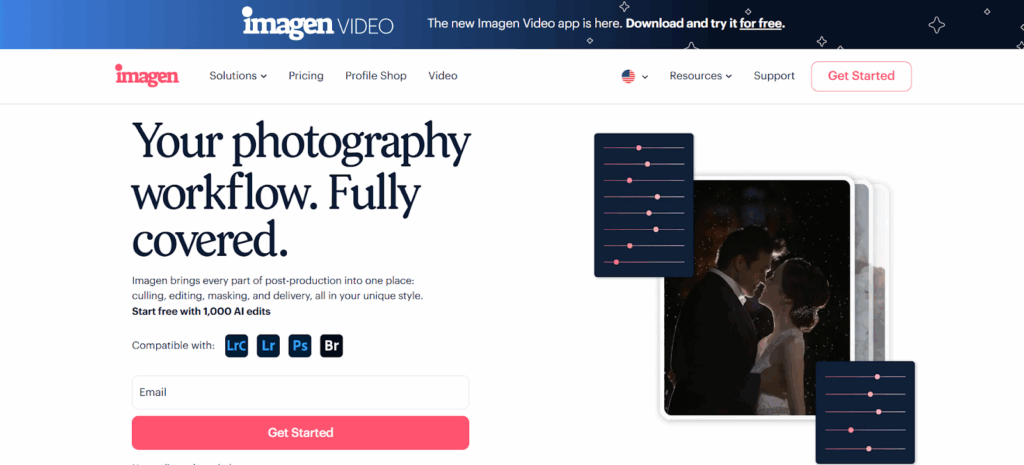
Imagen has fundamentally changed how professional photographers handle post-production. It is not just another outsourcing company with a team of manual editors. It is a desktop application that brings the power of AI directly to your workflow. Imagen works with Adobe Lightroom Classic, Lightroom, Photoshop, and Bridge, processing your photos in the cloud while you stay in control on your computer.
Specialized Capabilities for Real Estate
Real estate photography requires a specific set of technical edits that differ from weddings or portraits. You aren’t just color correcting; you are managing dynamic range, fixing geometry, and selling a lifestyle. Imagen addresses these specific challenges with dedicated AI tools designed for property workflows.
HDR Merge
High Dynamic Range (HDR) is essential for real estate. You need to show the bright view out the window and the dark interior corners in the same shot. Traditionally, this meant shooting brackets (3 to 5 photos at different exposures) and manually blending them. This process is slow and often results in “halo” effects or unnatural colors.
Imagen automates this entirely. You simply upload your brackets, and the AI merges them into a single, balanced image. It preserves the natural shadows and highlights without the fake “HDR look.” The AI analyzes the scene to decide which parts of each exposure to use, ensuring the final image looks natural and professional. This happens in seconds per image, not minutes.
Window Pull
The “million-dollar shot” in real estate often depends on the view. If a house has a view of the ocean or a mountain, you must show it. Often, the view is blown out (too bright) in the main exposure. Photographers traditionally use a “window pull” technique, manually masking the window and blending in a darker exposure. It is tedious, precise work.
Imagen’s Window Pull feature detects window panes automatically. It identifies the glass, creates a precise mask, and blends the correct exposure to reveal the view outside. You don’t need to brush or refine edges manually. The AI handles complex shapes, including window frames and mullions, ensuring the view is clear and vibrant. This specific capability turns a complex Photoshop task into an automated checkbox.
Perspective Correction
In real estate photography, vertical lines must be vertical. If a wall looks tilted, the house looks unstable. Correcting perspective (or “keystoning”) is a mandatory step for every single interior and exterior photo.
Imagen’s Perspective Correction tool analyzes the geometry of the image. It finds the vertical and horizontal lines and automatically warps the image to straighten them. It mimics the effect of using an expensive tilt-shift lens. The AI is smart enough to know which lines should be straight (like walls) and which shouldn’t (like vaulted ceilings), applying the correction only where needed.
Sky Replacement
A gray, overcast sky can make a beautiful property look dull. Replacing the sky with a bright blue one is a standard request from agents. Doing this manually involves selecting the sky (which is hard around trees and rooflines) and pasting in a new one.
Imagen includes a Sky Replacement tool specifically for real estate projects. The AI detects the sky area, even through complex tree branches or balcony railings, and swaps it for a beautiful set of blue skies. It creates a cleaner, more appealing main image that attracts buyers. Since this is built into the workflow, you don’t need to open Photoshop for every exterior shot.
A Comprehensive Platform for Photographers
Once the specific real estate challenges are met, Imagen fits into a broader, cohesive platform. It isn’t just a “one-trick pony” for HDR. It is a complete ecosystem for your photography business.
Personal AI Profile: Most editing services struggle with consistency because different human editors work on your photos. Imagen solves this by learning from you. You upload your previous edits, and the software creates a “Personal AI Profile.” This profile understands exactly how you like your white balance, contrast, and color. It applies your style to every photo, ensuring your portfolio looks consistent from house to house.
Culling: Before you edit, you have to cull. Imagen includes an AI culling feature that groups similar shots and flags the best ones. For real estate, it can help you quickly sort through brackets and pick the sharpest compositions.
Cloud Storage: Since real estate shoots generate massive amounts of data (especially with brackets), storage is a headache. Imagen offers optimized Cloud Storage. It backs up your photos while you edit. The unique part is that it handles high-resolution optimized files, saving space without losing quality. This ensures your projects are safe without needing dozens of hard drives.
Imagen stands out because it treats the entire workflow—from the memory card to the final delivery—as one unified process. It integrates these powerful real estate tools into a system that learns your style, making it the most efficient option for high-volume shooters in 2026.
2. BoxBrownie
BoxBrownie is a well-known name in the real estate marketing space. They operate on a “pay-as-you-go” model with a vast menu of services. They are not an AI software you run on your computer; they are a service bureau where you upload photos via a web browser, and a team of human editors processes them.
Their service list is extensive. Beyond standard image enhancement, they offer item removal, day-to-dusk conversions (virtual twilight), and floor plan redraws. They are particularly known for virtual staging, where they add digital furniture to photos of empty rooms.
The workflow is simple: you create an account, upload your JPEGs, select the specific services you need for each photo (e.g., “Image Enhancement” for 20 photos, “Virtual Staging” for 2), and pay the total fee. They typically promise a 24-hour turnaround for standard edits.
BoxBrownie is a solid option for agents or photographers who need specific, complex retouching tasks that go beyond standard color correction, such as removing a car from a driveway or digitally renovating a kitchen. Their “no subscription” model makes them accessible for low-volume users who don’t shoot every day.
3. PhotoUp
PhotoUp takes a slightly different approach by focusing on “dedicated editors.” While they offer on-demand editing similar to BoxBrownie, their core business model for professional photographers is renting a specific editor or a team of editors who work only for you.
This model aims to solve the consistency issue inherent in outsourcing. By working with the same person (or small team) repeatedly, you can train them on your specific preferences over time. They become an extension of your team rather than a nameless service.
PhotoUp also provides a broader suite of marketing tools. They offer virtual staging, single-property websites, and virtual assistants. Their platform allows you to manage not just the photo editing but also the delivery of marketing assets to real estate agents.
The turnaround time is generally 24 hours. They use a credit system for payment, and the cost varies depending on the complexity of the edit and your volume. For high-volume businesses that want a “human touch” and a personal relationship with an editor without hiring in-house, PhotoUp provides a structured solution.
4. Phixer
Phixer is a large editing company that combines an app-based interface with a global team of editors. They have a mobile app that appeals to real estate agents who might shoot with their phones, but they also serve professional photographers through their web portal.
Their primary selling point is speed and availability. With a massive team distributed globally, they can offer very fast turnaround times, sometimes as quick as 12 to 18 hours. They handle standard blending, color correction, and sky replacements.
Phixer supports video editing as well, which is becoming increasingly important in 2026. If you shoot listing videos or “reels” for social media, Phixer can edit those alongside your photos.
The quality can vary depending on the complexity of the request, as is common with large-scale manual editing farms. They offer standard pricing packages and a “pay-as-you-go” option. They are a volume-focused competitor suited for those who prioritize speed and have a standard “bright and airy” style requirement.
5. FixThePhoto
FixThePhoto is a traditional retouching agency that has been around for a long time. They cover all genres of photography, including portrait and wedding, but have a dedicated real estate section. Their approach is strictly manual retouching.
When you use FixThePhoto, you are essentially hiring a retoucher for a specific job. You upload your files and provide detailed instructions. Because they are generalists, they can handle very specific and unusual requests that automated systems might miss, such as removing a very specific reflection or fixing a complex piece of broken furniture.
Their real estate services include HDR blending, color cast removal, and perspective correction. They also offer high-end retouching for luxury properties where every detail needs to be perfect.
The downside of this model is often speed and consistency. Since it relies heavily on manual work, turnaround times can be longer than AI-driven or large-scale team solutions. Pricing is usually per-image, and it can add up for large brackets. They are a good “emergency” contact for difficult photos that need heavy Photoshop work.
6. BeatColor
BeatColor is a Vietnam-based editing company that specializes specifically in real estate photo editing. Vietnam has become a hub for real estate editing, and BeatColor is one of the more established players in this region.
They focus on providing a consistent “look” that is popular in real estate: bright windows, blue skies, and straight verticals. Their services include single exposure editing, HDR blending, and day-to-dusk conversion.
BeatColor is known for having a straightforward pricing structure and reliable 24-hour delivery. They are often more affordable than Western-based companies due to lower labor costs. They offer a team-based approach, so you may not get the same editor every time, but they have rigorous quality control (QC) processes to try and maintain standards.
For photographers looking for a budget-friendly option for high-volume work, BeatColor is a strong contender. They handle the bulk work of blending and straightening well, provided your style aligns with their standard output.
7. WeEdit.Photos
WeEdit.Photos is another volume-focused editing service that caters to real estate and portrait photographers. They position themselves as a cost-effective solution for busy photographers who need to clear their queue quickly.
They offer a simplified pricing model, often with flat rates for standard editing packages. Their services cover the essentials: culling, color correction, cropping, and straightening. For real estate, they perform the standard HDR blends and sky replacements.
One of their features is a “Enterprise” option for very high-volume studios, where pricing can be negotiated based on volume. They have a user-friendly dashboard for tracking orders and status.
WeEdit.Photos is purely a service provider; they do not offer software or AI tools for you to use. You upload, wait, and download. They are a functional choice for photographers who want a “set it and forget it” outsourcing partner and aren’t too picky about having a personalized AI profile.
8. SmartPHOTOEditors
SmartPHOTOEditors is an India-based service provider that offers a wide range of image editing services, including a dedicated real estate division. They are part of a larger outsourcing group, which gives them the ability to scale up quickly for large projects.
They offer granular control over editing tasks. You can request specific edits like “lawn enhancement” (making dead grass green) or “pool water cleaning.” They are particularly good at handling tedious cleanup tasks that can take hours in Photoshop.
Their model is based on labor arbitrage, offering very low per-image rates. This makes them attractive to new photographers or those with very tight margins. However, the communication can sometimes be slower due to time zone differences and the size of the company.
They are a valid option if you have a backlog of photos that need heavy object removal or cleanup that goes beyond standard color correction.
9. PixelShouters
PixelShouters is a specialized boutique editing company focused entirely on real estate. Unlike the massive generalist firms, they market themselves as experts in the specific aesthetic of property marketing.
They offer a tiered service structure, often labeled as “Standard,” “Premium,” and “Luxury.” This allows you to choose the level of polish based on the listing price of the home. A million-dollar listing might get the “Luxury” treatment with hand-blended windows and meticulous color matching, while a rental listing gets the “Standard” package.
They emphasize high-quality HDR blending and “flambient” (flash + ambient) blending capabilities. If you shoot flambient—a complex technique involving multiple flash pops—PixelShouters is one of the better manual options, as this technique is hard to automate or outsource to inexperienced editors.
Their pricing is higher than the budget providers’, but the focus is on higher-quality output for premium listings.
10. SunTec India
SunTec India is a massive IT and business process outsourcing (BPO) company. Photo editing is just one of their many verticals. They are the “industrial” option on this list, suited for large agencies or platforms that need to process thousands of images daily.
They offer Real Estate Photo Editing, stitching for 360-degree virtual tours, and floor plan creation. Because of their size, they have robust infrastructure and security protocols, which appeal to corporate clients.
Their workflow is highly standardized. You generally won’t have a personal relationship with an editor here; you are plugging into a processing pipeline. Pricing is extremely competitive at high volumes.
For an individual photographer, SunTec might feel impersonal, but for a large real estate photography agency that needs a reliable, always-on back-office solution to handle overflow, they are a logical choice.
How to Choose the Best Real Estate Editing Service in 2026
Selecting an editing partner is a strategic business decision. In 2026, the gap between AI-driven software and manual service bureaus has widened. Here is a guide on the criteria you should use to make your choice.
1. Consistency
This is the single most important factor. An agent will fire you if the kitchen looks blue in one shot and yellow in the next.
- Manual Services: Consistency is the biggest challenge. You might get “Editor A” on Monday, who loves contrast, and “Editor B” on Tuesday, who loves bright shadows. You end up spending time fixing their inconsistencies.
- AI Software (Imagen): This is where AI wins. A Personal AI Profile learns your style. It applies the exact same mathematical values for temperature and tint across the board. The consistency is mathematically precise.
2. Turnaround Time
Real estate is a “need it yesterday” industry.
- Manual Services: The standard is 12-24 hours. If you shoot on Friday, you might not get photos until Saturday afternoon or Sunday. Rush fees often apply for faster delivery.
- AI Software: The turnaround is measured in minutes. You can upload a shoot, go make a coffee, and have the edits back before you finish the cup. This allows you to offer “same-day delivery” to clients as a premium service without working late.
3. Cost and Scalability
Look at your margins.
- Pay-Per-Image: Services like BoxBrownie charge per photo (e.g., $1.60/image). If you deliver 40 photos, that’s $64. This eats into your profit significantly.
- Subscription/Credit Software: Desktop solutions usually have a much lower cost per image (often cents, not dollars) or a flat subscription. For high-volume shooters doing 20+ homes a month, software is vastly cheaper.
4. Technology and Control
- Web-Based: You upload JPEGs to a website. You lose raw data capabilities. If the edit is bad, you have to request a revision and wait another 24 hours.
- Desktop App (Imagen): You work with Lightroom Classic catalogs. The Smart Previews allow for fast transfer. The edits come back as metadata (sliders moved in Lightroom). This is crucial. If the exposure is slightly off, you just tweak the slider. You maintain full non-destructive control over your RAW files.
5. Specialized Features
Does the service understand real estate?
- Generic editors might try to smooth skin on a homeowner’s portrait on the wall.
- Real estate-focused tools (like Imagen’s Window Pull and Sky Replacement) are built for the geometry and dynamic range of architecture. Ensure the service you pick has specific workflows for HDR and vertical correction.
Conclusion
The landscape of real estate editing in 2026 is defined by the shift from manual labor to intelligent automation. While manual service bureaus like BoxBrownie and PhotoUp still have a place for specialized retouching and virtual staging, the day-to-day heavy lifting of processing listings is moving to AI.
Imagen leads this list not because of hype, but because of architecture. It is a desktop-first, AI-driven platform that integrates with the tools professionals already use (Lightroom). By solving the specific pain points of real estate—HDR blending, window pulls, and perspective correction—with instant turnaround and learning consistency, it offers the most scalable path forward for modern photographers.
Your choice depends on your volume and business model. If you shoot one house a month, a pay-as-you-go service is fine. If you shoot two houses a day, you need the speed, consistency, and cost-efficiency that only an AI-powered desktop workflow can provide.
Frequently Asked Questions
1. Why is AI editing considered better for real estate than manual editing? AI editing offers superior consistency and speed. Manual editors can have “off days” or vary in style between individuals. AI applies the same stylistic parameters to every single image, ensuring a cohesive look for the entire property. Additionally, AI returns edits in minutes rather than the standard 24-hour turnaround of manual services.
2. Can I use Imagen if I don’t use Adobe Lightroom? Imagen is designed to integrate deeply with Adobe’s ecosystem. It supports Lightroom Classic, Lightroom (CC), Photoshop, and Bridge. The core value of Imagen is that it adjusts the editing parameters within these programs non-destructively. If you use Capture One or other raw processors, you would need to adjust your workflow to utilize Imagen’s full capabilities.
3. What is the difference between “Virtual Staging” and standard editing? Standard editing involves correcting the lighting, color, and geometry of existing elements. Virtual staging involves adding digital assets—like sofas, beds, and rugs—to photos of empty rooms. Services like BoxBrownie excel at virtual staging, while Imagen focuses on the core photographic editing and enhancement.
4. How does “Sky Replacement” work in real estate editing? Sky replacement involves masking out a dull or gray sky and replacing it with a blue, sunny sky. In manual editing, a human uses a brush or selection tool. In AI editing (like Imagen), the software automatically detects the sky (even behind trees) and inserts a high-resolution sky replacement, matching the color temperature of the foreground to make it look realistic.
5. Is my data secure when using these services? Security varies by provider. Desktop apps like Imagen process edits in the cloud but don’t require you to upload high-res raw files for the actual editing parameters (they use Smart Previews), which is faster and often more secure. Services like SunTec India have enterprise-grade security protocols. Always check if a service uses your images to train their models without permission or if they claim ownership of the files.
6. Do I need to shoot brackets (HDR) for real estate? In 2026, bracketing is still the standard for high-quality interiors to capture the dynamic range between dark rooms and bright windows. However, with advanced sensors and “flambient” techniques, some photographers shoot single exposures. Imagen supports both workflows, but its “HDR Merge” tool is specifically designed to optimize bracketed shots automatically.
7. What is “Window Pull” and why do I need it? A window pull is a technique to show the view outside a window clearly, rather than having it blown out to white. It is crucial for properties with views. Imagen’s Window Pull feature automates the complex masking required to blend the darker window exposure with the brighter interior exposure.
8. Can these services fix a messy house? Standard editing cannot clean a messy room. You need “Decluttering” or “Object Removal” services. BoxBrownie and Phixer offer specific item removal services (for a fee) to digitally remove boxes, cars, or clutter. Imagen’s primary focus is on enhancing the photo, though object removal tools are advancing rapidly.
9. How much should I expect to pay for real estate editing? Manual services typically charge between $1.00 and $2.00 per image. Virtual staging can cost $15-$30 per image. AI-based solutions like Imagen operate on a much lower cost-per-image basis (often cents per edit) or a subscription model, making them significantly cheaper for high-volume work.
10. What happens if I don’t like the edits? With manual services, you must request a revision and wait (usually 12-24 hours). With Imagen, since the edits are applied as metadata in Lightroom, you can simply tweak the exposure or white balance slider yourself instantly. You have full control and don’t have to wait for someone else to fix it.
11. Is “Perspective Correction” really necessary? Yes. In real estate photography, vertical lines (walls, door frames) must be perfectly vertical. If they converge (lean in), the photo looks amateurish. Professional services and tools like Imagen apply perspective correction to every single photo to ensure architectural accuracy.
12. Can I use these services for video editing, too? Some services, like Phixer and BoxBrownie, offer video editing for real estate walkthroughs and social media reels. Imagen is primarily focused on still photography post-production, though the industry is converging.
13. How do I start with a Personal AI Profile? To create a Personal AI Profile with Imagen, you upload a set of your previously edited photos (usually around 2,000 images from Lightroom). The AI analyzes these to learn your style. If you don’t have that many, you can use a “Talent Profile” (pre-made styles by pros) or a “Lite Profile” based on a preset and a questionnaire to get started immediately.